

For two winters running, San Diego sat under La Niña conditions, which typically mean a drier-than-average rainy season for Southern California. That streak is ending.
In April, the National Weather Service’s Climate Prediction Center issued an El Niño Watch, the first step in officially tracking a pattern shift. The outlook isn’t subtle about what could follow: warmer equatorial Pacific waters that, in past strong events, have translated into heavier winter storms along the California coast.
What the Forecast Actually Says
According to the Climate Prediction Center’s April report, there’s a 25% chance the pattern develops into a strong or very strong El Niño by winter. That’s not a guarantee of a wet season. Meteorologists are quick to point out that El Niño isn’t a storm system itself, and some past El Niño years, including the very strong 2015-16 event, turned out unusually dry for parts of Southern California.
But the uncertainty cuts both ways, and homeowners planning outdoor construction this year are increasingly building around the higher end of that range rather than the lower one. A patio cover or pergola started in late summer, before the pattern fully develops, gives a contractor a wider construction window than one started in January during an active storm cycle.
Why Covered Structures Are the Practical Response
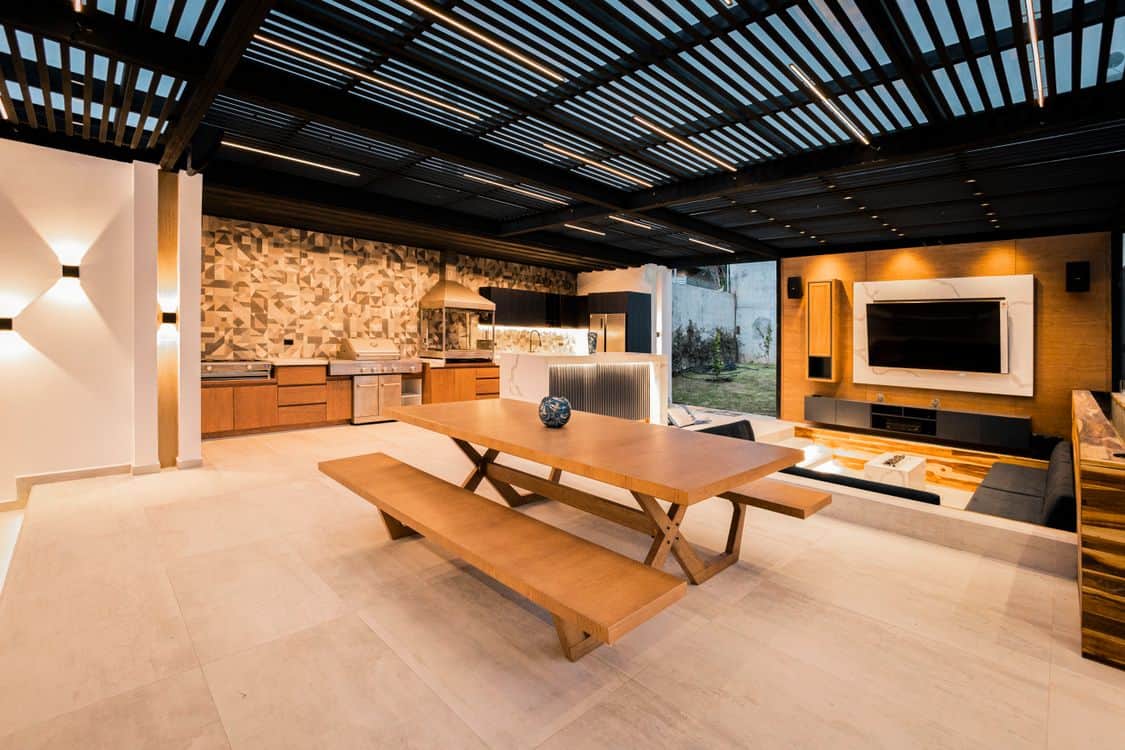
An uncovered patio doesn’t fail in a wet winter so much as it becomes unusable for stretches of it. Furniture gets covered or stored, cushions get hauled inside, and a space that’s supposed to extend the living area for most of the year sits empty during exactly the months people are home more and want somewhere dry to sit.
A pergola with a solid or louvered roof changes that equation. Motorized louvered systems in particular let homeowners adjust for sun, shade, or rain protection without giving up open-air ventilation the rest of the year, which matters in a climate where most days don’t call for full enclosure.
There’s a structural argument too. Patio covers and pergolas built to current wind and rain-load standards are engineered to shed water away from the house, not toward the foundation, which becomes more relevant in a season where storm intensity, even if infrequent, tends to be more concentrated than a typical San Diego winter.
Building Ahead of Uncertainty, Not in Response to It
Nobody can say with confidence in July whether this winter turns out wet, dry, or somewhere in between. That’s the nature of the forecast at this stage, and meteorologists have been explicit that strength of an El Niño doesn’t reliably predict local rainfall totals.
What the elevated odds have done is shift the timing conversation. Homeowners who might have put off a patio cover project until spring are increasingly starting now, when contractor schedules are open and the ground is dry, rather than waiting to see what the forecast confirms later in the year.






Leave a Comment